Projectile Game Rebuilt: Four Levels, New Controls, and an Animated Tutorial
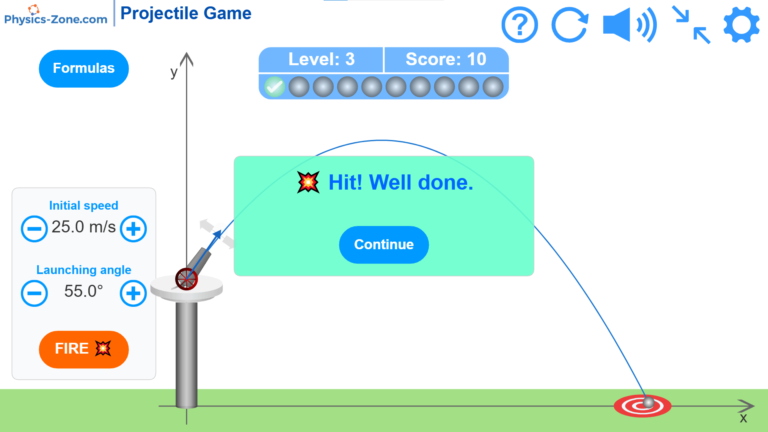
The old version had three levels. There are now four, along with drag controls, a formulas panel, and a tutorial that operates the controls instead of pointing at them.
Updates, fixes, and articles about Physics Zone’s simulations and educational resources.

The old version had three levels. There are now four, along with drag controls, a formulas panel, and a tutorial that operates the controls instead of pointing at them.

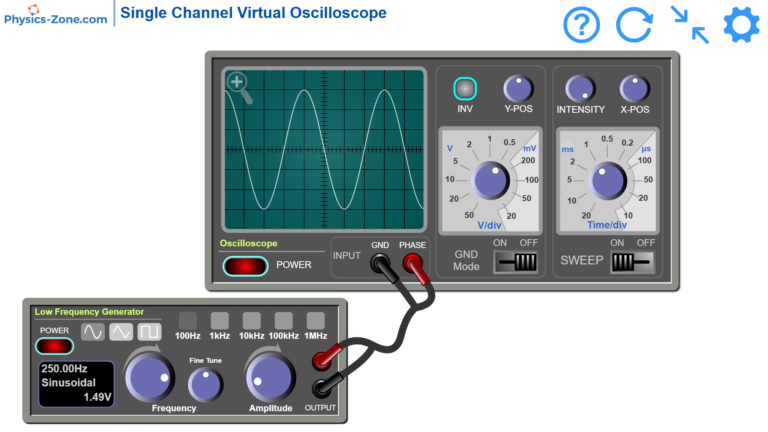
A free interactive single-channel virtual oscilloscope simulation for intermediate physics classes. Connect a function generator or DC source and observe sine, triangular, and square waveforms in real time with adjustable frequency and amplitude.

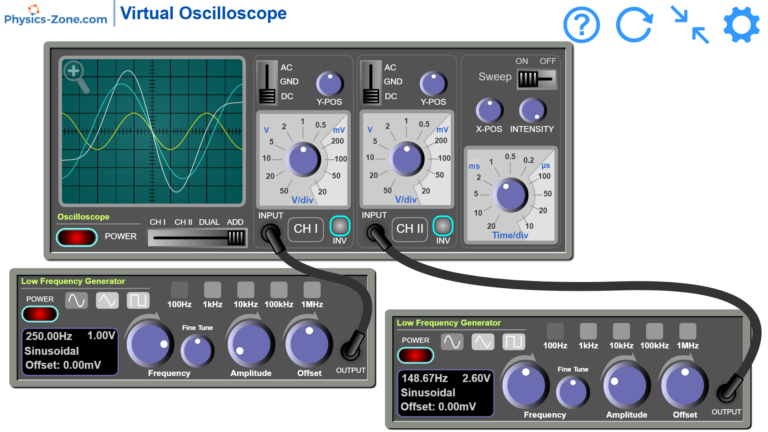
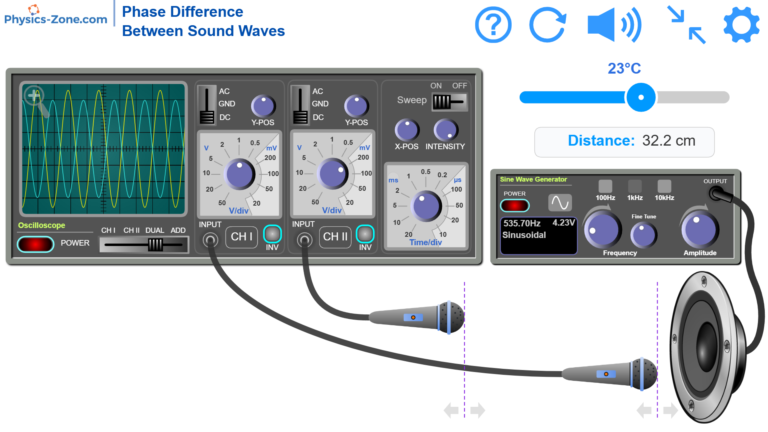
A new release of the Virtual Oscilloscope simulation introduces Signal Addition (ADD) mode for exploring superposition, along with frequency fine-tuning, a screen magnifier, and a cleaner interface.

A new version of the Virtual Oscilloscope on Physics Zone is now available for beta testing. This update introduces Signal Addition (ADD) mode, allowing the sum of two independent signals to be displayed in real time on the oscilloscope screen.

A comprehensive revision of simulation manuals has identified and corrected several errors in the Elastic Collision, Photoelectric Effect, and Virtual Oscilloscope manuals. All corrections are now live, and the PDF download option has been removed in favor of keeping the online versions up to date.

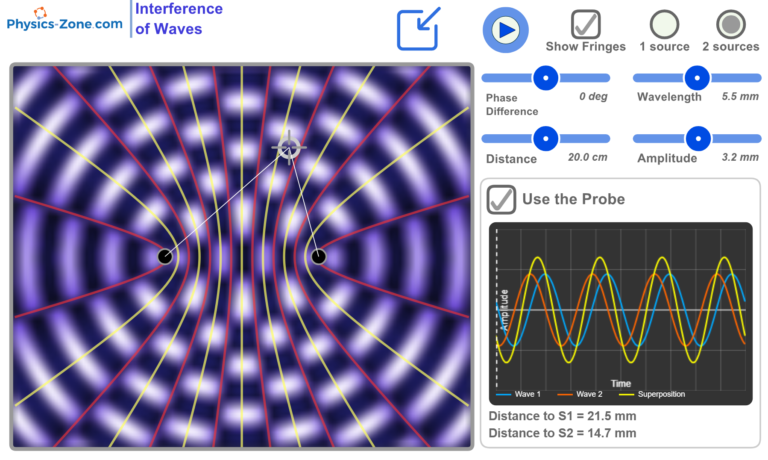
The probe waveform display in Interference of Waves Simulation now renders mathematically perfect sinusoidal waves, making phase relationships and superposition easier to observe and more reliable as a teaching and learning tool.

Touch support has been restored for all interactive simulations. Draggable elements now work properly on modern smartboards, Promethean boards, and Windows touchscreen devices.

Quick update for iOS users: all Physics Zone simulations now run smoothly on iPhones, iPads, and Macs after fixing the full-screen toggle issue.

All simulations have been updated to use a locally hosted CreateJS library instead of an external one, resulting in faster loading, smoother performance, and improved reliability.

The paper: Using a web-based and stand-alone oscilloscope for physics experiment during Covid-19 pandemic, Mahizah Ismail et al (2023), Phys. Educ. 58 015006, is based on the Virtual Oscilloscope simulation. This paper was authored by Mahizah Ismail, Farid Minawi, Wan Zul Adli Wan Mokhtar, Noraihan L Abdul Rashid and Ahmad K Ariffin.
The article DOI: https://iopscience.iop.org/article/10.1088/1361-6552/ac95eb