Projectile Game Rebuilt: Four Levels, New Controls, and an Animated Tutorial
The old version had three levels. There are now four, along with drag controls, a formulas panel, and a tutorial that operates the controls instead of pointing at them.

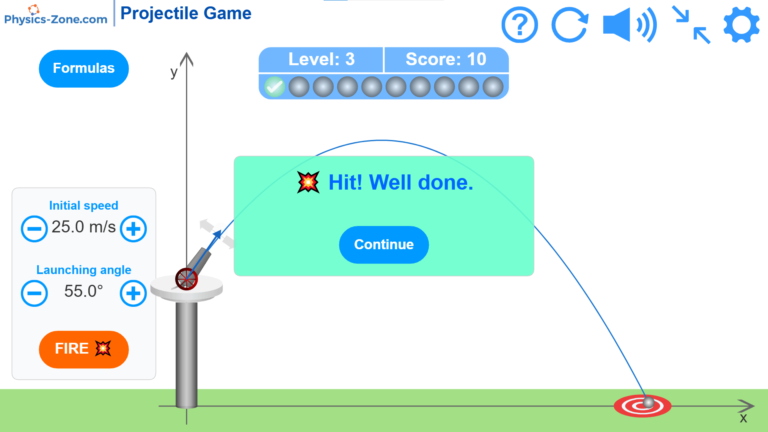
The old version had three levels. There are now four, along with drag controls, a formulas panel, and a tutorial that operates the controls instead of pointing at them.
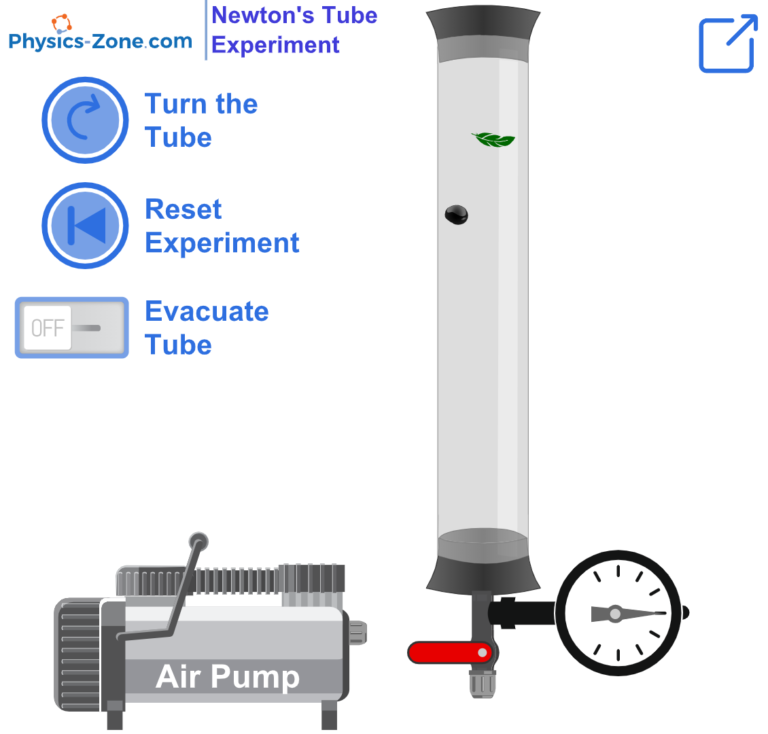
This simulation models Newton’s tube experiment, showing how air resistance affects falling objects. By removing air from the tube and flipping it, users can observe how a feather and a pebble fall differently in air but identically in a vacuum—demonstrating that gravity accelerates all objects equally when air resistance is removed.
Measure the target, apply the right equation, and fire one calculated shot. Four levels of projectile motion – level ground, a wall, an elevated cannon, and an elevated target.
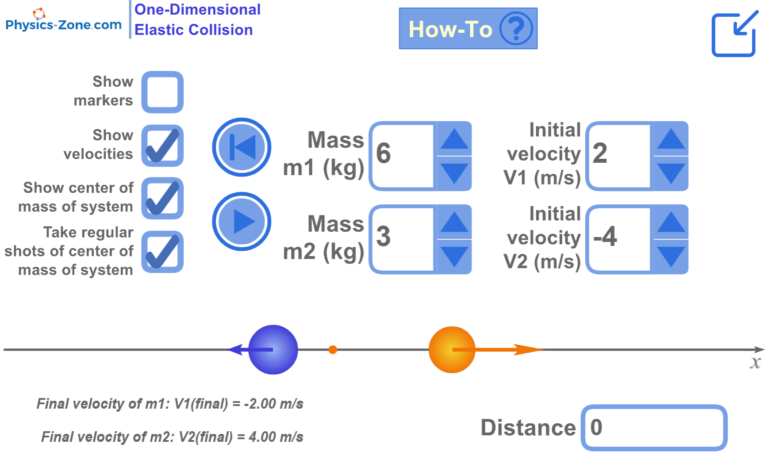
A complete manual for the elastic collision in one dimension simulation, with a mathematical explanation of the derivation of the expressions of the final velocities in terms of the masses and the initial velocities.
Demonstrate the conservation of linear momentum and kinetic energy in a one-dimensional elastic collision using this interactive physics simulation.
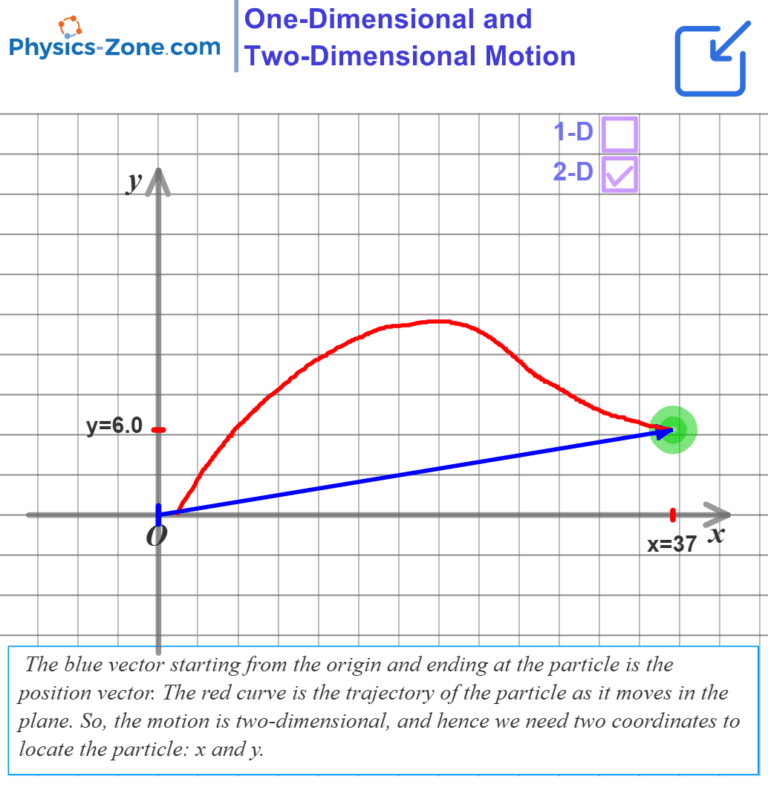
This simulation demonstrates the difference between one-dimensional motion along the x-axis and two-dimensional motion using both x- and y-axes in a Cartesian system.
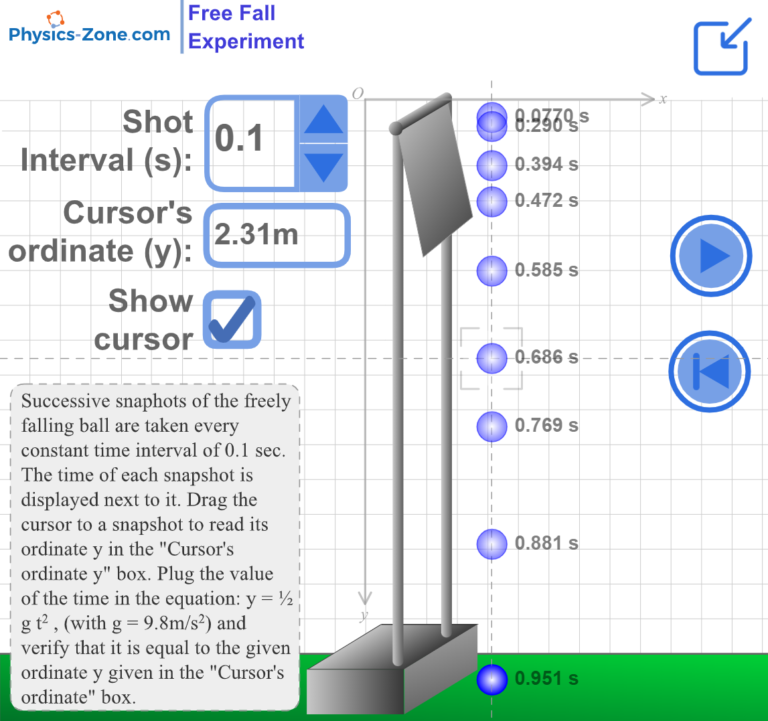
This simulation models the free fall of a ball, allowing users to measure the acceleration due to gravity by tracking time and position snapshots, and verifying the equation y = (1/2)gt².