Projectile Game Rebuilt: Four Levels, New Controls, and an Animated Tutorial
The old version had three levels. There are now four, along with drag controls, a formulas panel, and a tutorial that operates the controls instead of pointing at them.

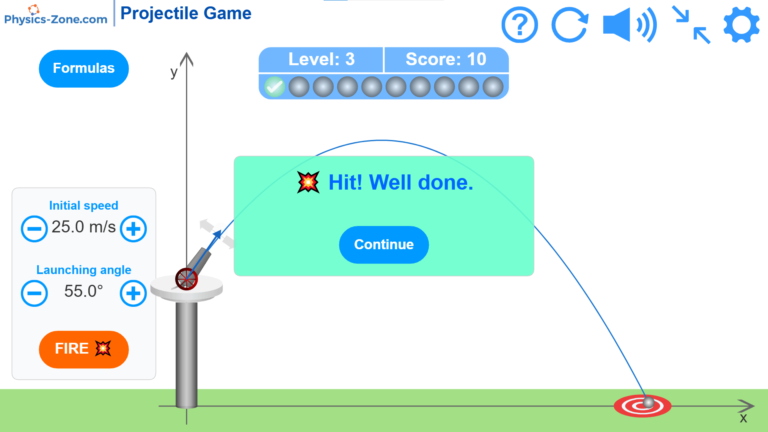
The old version had three levels. There are now four, along with drag controls, a formulas panel, and a tutorial that operates the controls instead of pointing at them.
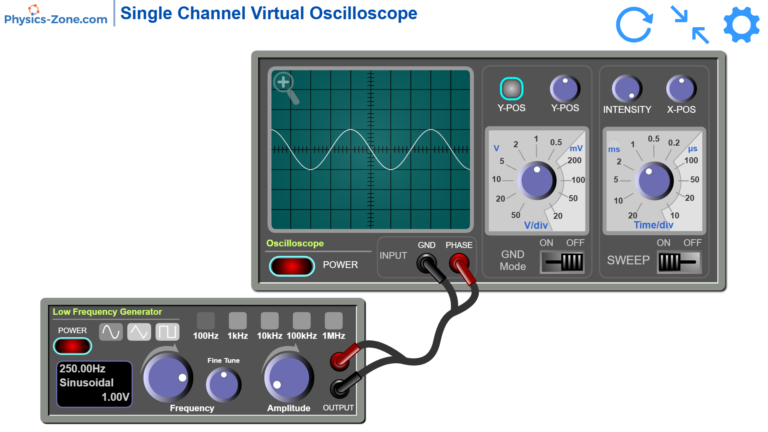
A free interactive single-channel virtual oscilloscope simulation for intermediate physics classes. Connect a function generator or DC source and observe sine, triangular, and square waveforms in real time with adjustable frequency and amplitude.
A free interactive single-channel virtual oscilloscope simulation for intermediate physics classes. Connect a function generator or DC source and observe sine, triangular, and square waveforms in real time with adjustable frequency and amplitude.
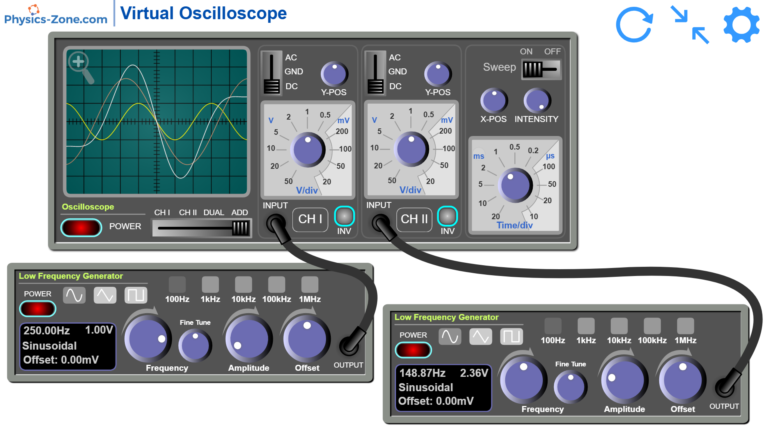
A new release of the Virtual Oscilloscope simulation introduces Signal Addition (ADD) mode for exploring superposition, along with frequency fine-tuning, a screen magnifier, and a cleaner interface.
A new version of the Virtual Oscilloscope on Physics Zone is now available for beta testing. This update introduces Signal Addition (ADD) mode, allowing the sum of two independent signals to be displayed in real time on the oscilloscope screen.
Measure the target, apply the right equation, and fire one calculated shot. Four levels of projectile motion – level ground, a wall, an elevated cannon, and an elevated target.
The paper: Using a web-based and stand-alone oscilloscope for physics experiment during Covid-19 pandemic, Mahizah Ismail et al (2023), Phys. Educ. 58 015006, is based on the Virtual Oscilloscope simulation. This paper was authored by Mahizah Ismail, Farid Minawi, Wan Zul Adli Wan Mokhtar, Noraihan L Abdul Rashid and Ahmad K Ariffin.
The article DOI: https://iopscience.iop.org/article/10.1088/1361-6552/ac95eb
A helpful dual-channel oscilloscope simulation for students and teachers. Connect to AC or DC generators, visualize real-time waveforms, and add two signals together to explore superposition — just as on a physical oscilloscope.