
Why This Hooke’s Law Simulation Has No Slider
Why this spring experiment has no slider
Most spring simulations give you a slider. Drag it, and a number labeled “force” changes. The graph draws itself. Nothing has been measured.
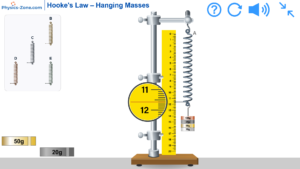
In Hooke’s Law – Hanging Masses, force is not an input. It is something the student assembles: a 10 g hanger goes on first, because everything stacks on it, then masses are added one at a time. To find the force, the student converts the hanging mass themselves. To find the extension, they read the spring’s total length off the ruler and subtract the no-load reading. Both of those steps are where the physics lives, and a slider removes them both.
The springs are not interchangeable
There are five, each with a different stiffness and its own elastic limit, and the value of k appears nowhere on screen. Three of them give readings that land exactly on a millimeter division; the other two do not. Groups working on different springs therefore meet the same law through different arithmetic, which is useful when you want them to compare results rather than copy them.
The assignment is fixed: spring C is the same spring in every session and on every computer, so a class can be graded against one answer key.
A spring can be ruined, and the damage can be measured
Load one past its elastic limit and it yields: it stretches further than the law predicts and keeps part of that stretch for good. Take the masses off and it does not return to its original length. It settles at a new, longer one, and the student measures the difference themselves. Each of the five springs keeps a different amount, so groups comparing ruined springs get different answers.
This is deliberate. Elasticity is a range, not a property, and a student who has ruined a spring has learned where that range ends better than one who has been told.
Finding the elastic limit the way a lab does
Because a deformed spring can still be loaded and unloaded, the limit can be found rather than announced. Load the spring, read it, take the masses off, and check that it returns to its original length. Repeat with a heavier load. The elastic limit lies between the heaviest load the spring recovered from and the first one that left it permanently longer – the same bracketing a technician would do at the bench. Nothing on screen states the answer.
A note on g
The simulation does not state a value for g, because classes differ. If your students use 10 N/kg the spring constants come out as whole numbers; with 9.8 N/kg every result is 2% lower and consistent to two decimal places. Either is correct, and the conclusion is unaffected – but decide before the class starts, because mixed conventions in one set of reports are hard to grade.
Open the simulation